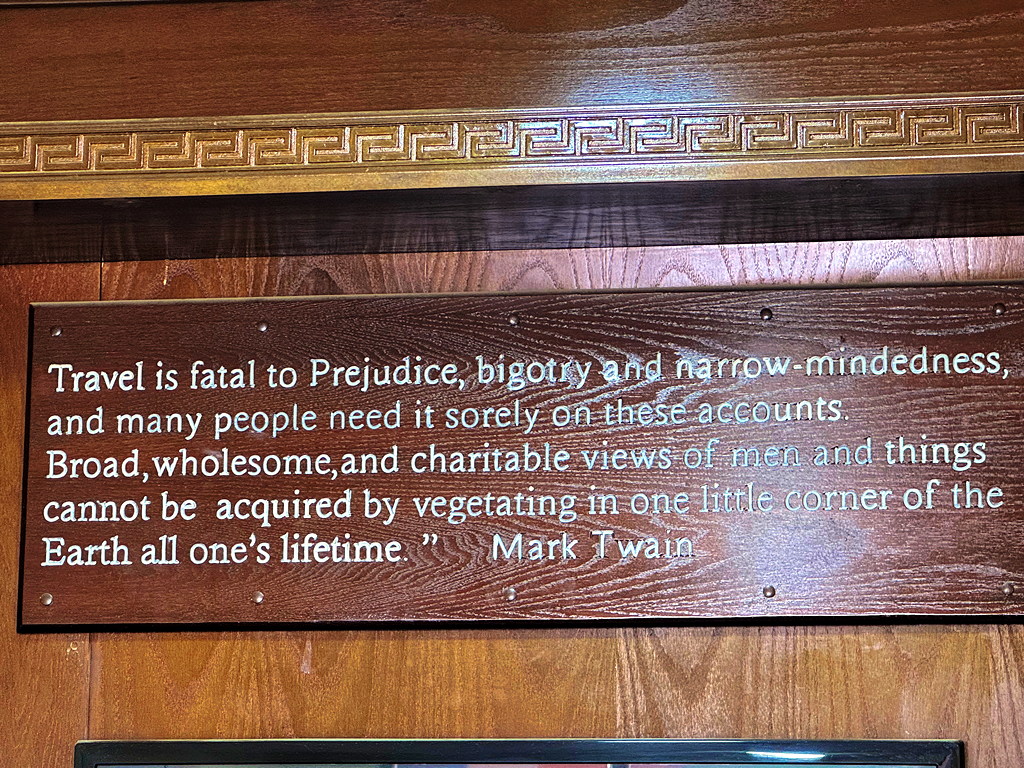
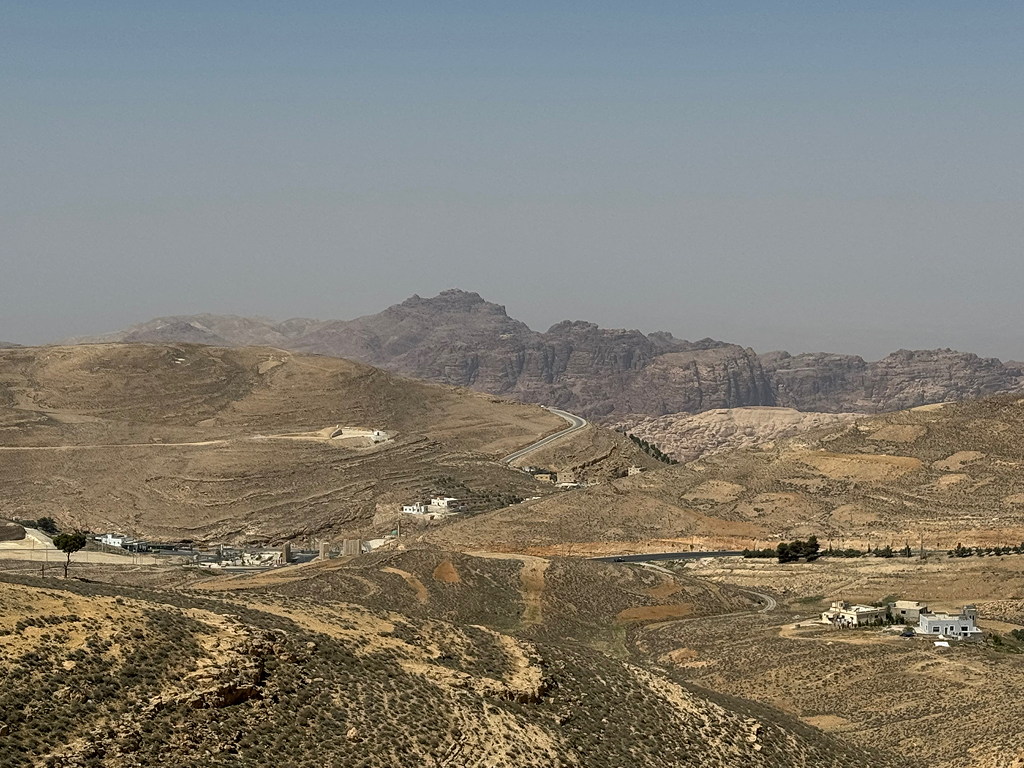
I had a really marvelous day on the 3rd. Anas, my driver arrived a bit before 8 am as I was finishing breakfast in the hotel. It was a long drive from Amman to Petra – over 3 hours long, so Anas and I had plenty of time to talk. Turns out that he was using Duolingo to study French just like I am and we both liked similar movies – we had a long John Wick vs Jason Bourne discussion which some how morphed into a music discussion – all Arabian song are about home or love, he said. I don’t think that is quite true of American pop songs. We classified some American pop songs he knew in one or the other category, but then there were the ones which were not big in the Middle East like “Fast Car” and “Cold Feet” by Tracy Chapman which don’t fit though I could argue that both belong in the love category. Still, where do you put songs like “Hotel California” by The Eagles or “Billy Jean” by Michael Jackson? We thought home for the first and love for the second though both classifications are a stretch. We did make a stop for food and more coffee; I bought a scarf as a present for my upstairs neighbor who’s looking after my apartment; I avoided buying a very nice inlaid wood backgammon set. We made another briefer stop outside Petra where one could see the geography around the basin. After so much flat or slightly undulating land, the mountains near Wadi Musa and around Petra looked very distinctive in color. The highest peak of dark stone is supposed to be the site of the tomb of Moses’ brother, Aaron (https://en.wikipedia.org/wiki/Tomb_of_Aaron_(Jordan)).
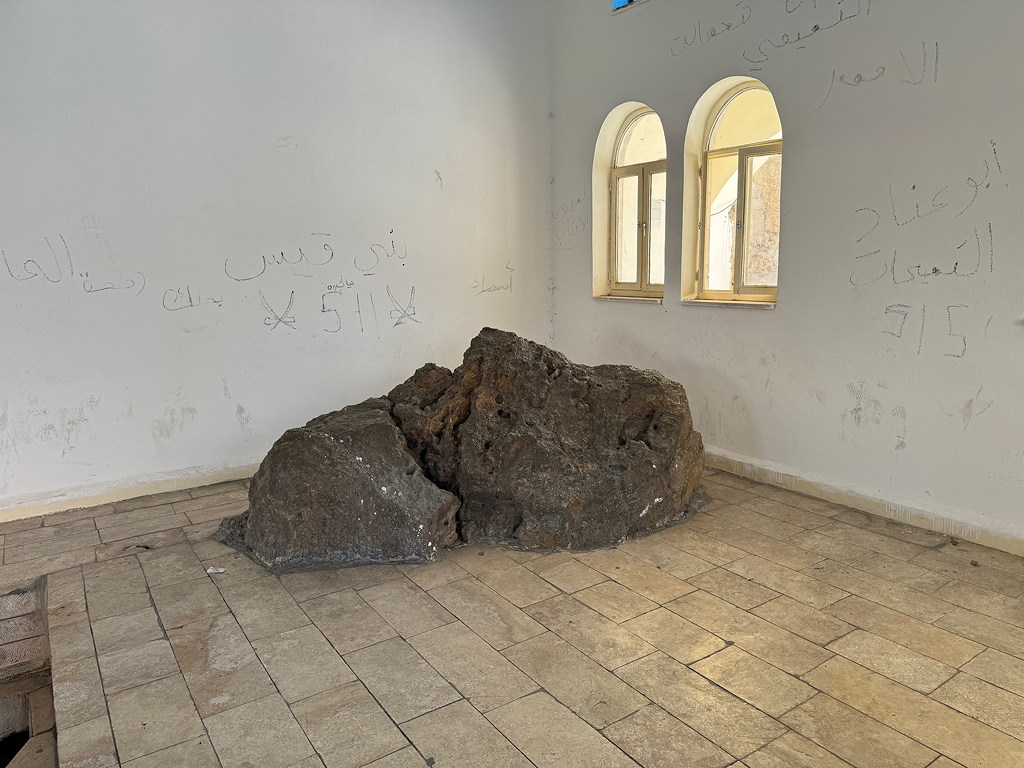
Once in Wadi Musa, Anas showed me a building containing the rock Moses struck the second time to get water for the Israelites in the Old Testament. A substantial flow of water still comes from beneath the rock today and is used for drinking water. This lead to a discussion about how many people on our planet have a religion based on the same or similar texts – the Old Testament, the Torah and the Quran share a lot of text; it’s in the translation, interpretation and elaboration of those texts where the religions diverge. Anas and I talked a lot about these and other issues; I can barely begin to capture the breadth and depth of all of our discussions during the entire day – films, music, religion vs faith, languages, Middle East politics, travel etc were just a start.
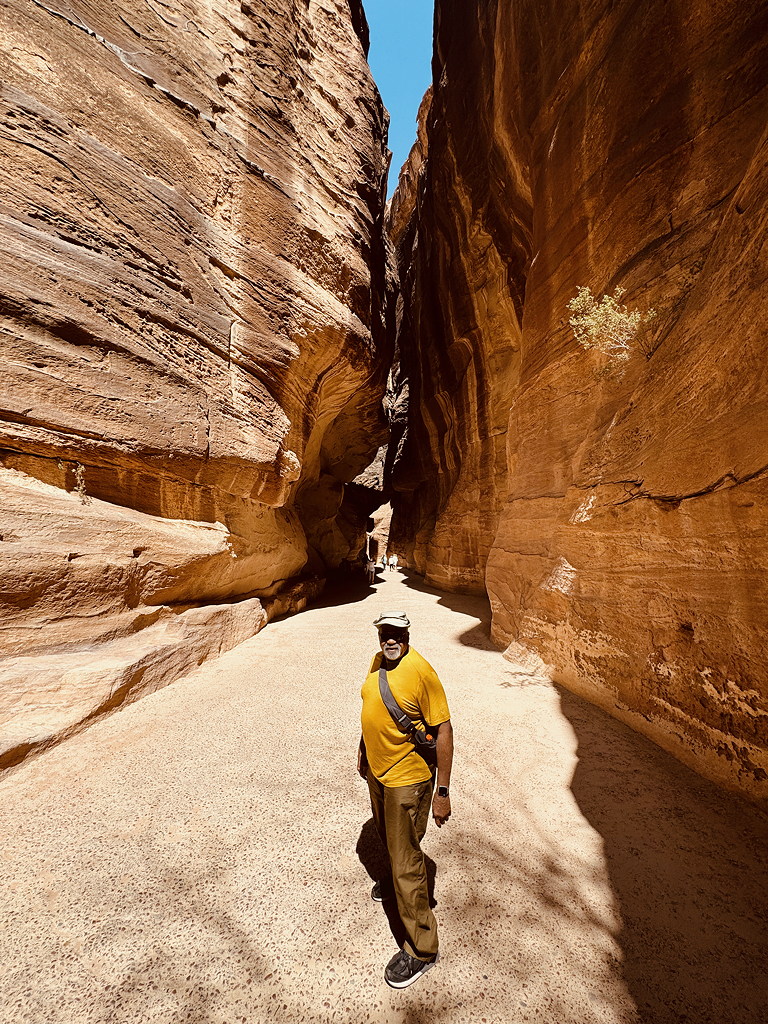
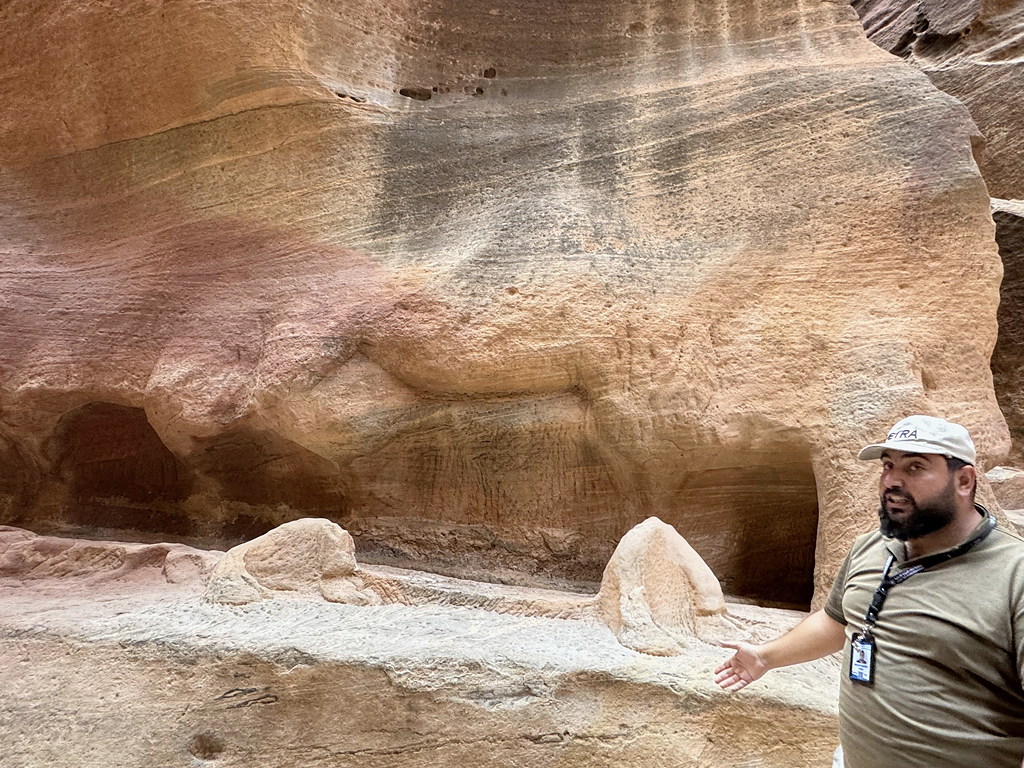
Anas took me to Petra and found an English speaking guide, Khaled, for me. I was wary of walking so long a distance to get into Petra that I would only have an agonizing walk and little energy to leave Petra. I was able to hire a golf cart to take me thru the Siq to the Treasury building, then I would be able to walk through Petra to pick up a tourist shuttle on the other side. Khaled was a local man who grew up very nearby – less than a kilometer away and knew a lot about the Nabataean people who built Petra (https://www.nationalgeographic.com/travel/world-heritage/article/petra-jordan) since they were his ancestors. He said that he’d heard stories associated with the facts he learned to be a guide while growing up. A mechanical engineer by training and occupation, he was forced to switch jobs when COVID put his and many other companies out of business. Even now the war in Gaza is inhibiting tourism travel so badly that Khaled estimated that less than 10% of the normal tourism traffic was coming to Petra. I really did not mind being able to take my time to watch the changing light on the Treasury without the crush of hundreds of people around me. In an odd way, I was once again reminded that much of the power that built Petra and the Pyramids was human power – construction limited only by imagination and the loads humans could carry singly or in groups.
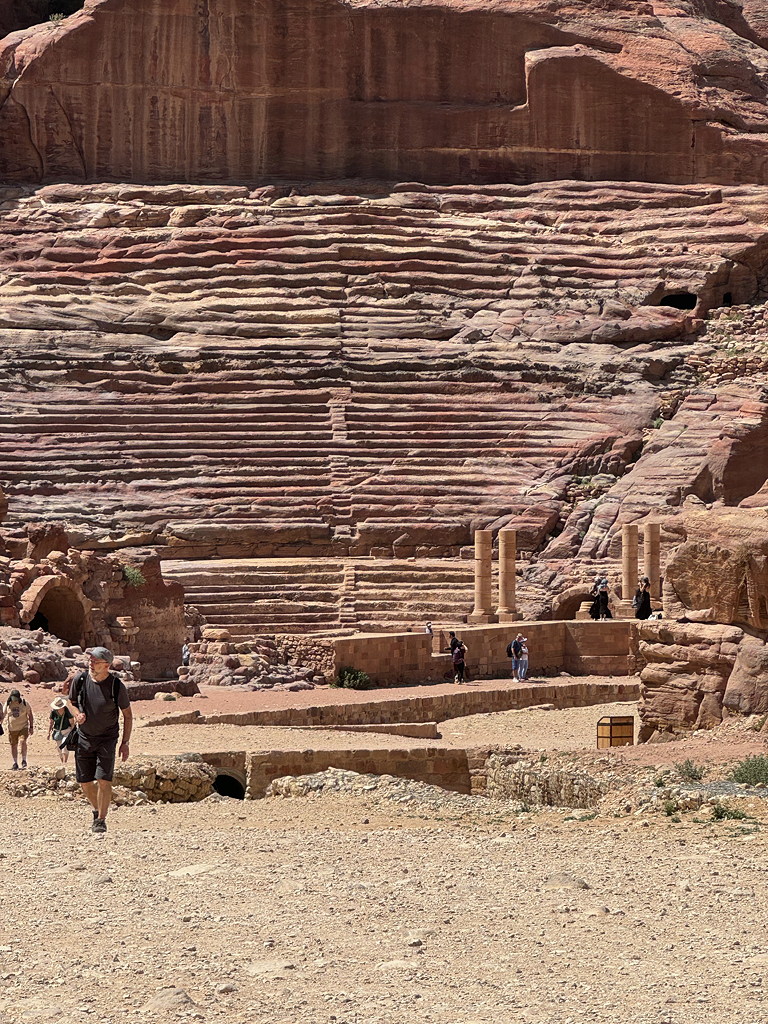
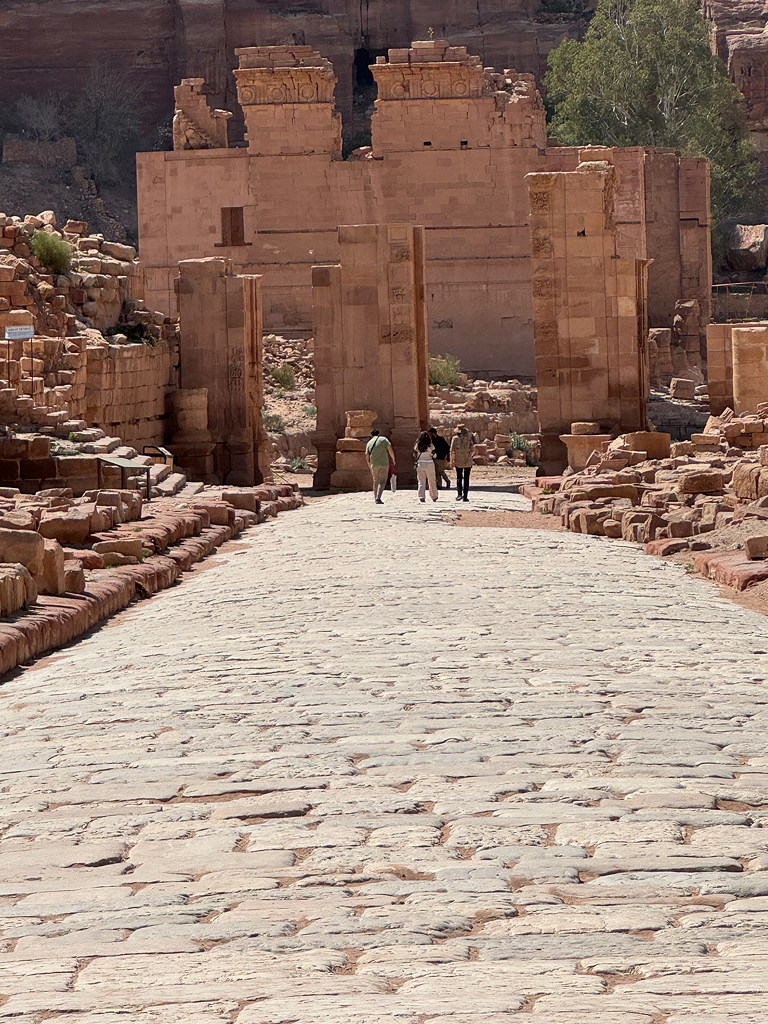
Petra itself is amazing to see (https://whc.unesco.org/en/list/326/): the canals which brought rain and runoff water into the city are dry but still there, complete with sediment catch basins and dams. Most of what we associate with being Petra are actually carved tombs like the Treasury and the Royal Tombs higher up. The amphitheater is unique because it was carved from solid rock rather than being built from stone slabs like the Greek or Roman ones. Though the stone ruins of some commercial spaces are apparent, most of the city of Petra was built of organic material which did not last through time and earthquakes. At its peak, archeologists estimate that around 20,000 people lived in the area. Earthquakes and changing economics forced most people to abandon the city in the 500’s CE; at some point, the city was “lost” and became a subject of rumor until the early-1800s when it was “rediscovered” by Johann Ludwig Burckhardt – Khaled said that the locals always knew the city was there and actively kept it hidden by misleading or by killing explorers who became too inquisitive. Burckhardt succeeded in reaching the city because he spoke only Arabic and pretended to want to sacrifice a goat at Aaron’s Tomb near the city (https://en.wikipedia.org/wiki/Petra).



 Round the World in 110 days